Welcome to

Srivatsa’s Golu

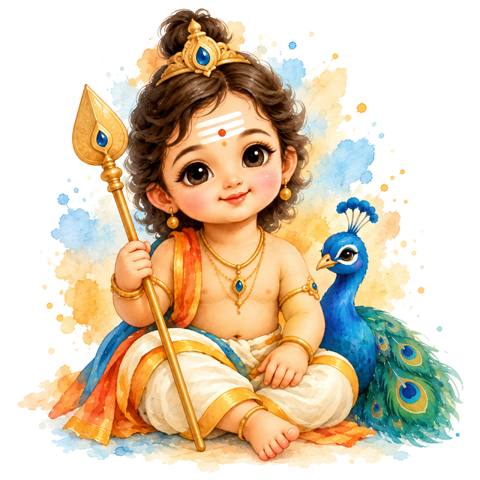
Baby Murugan with his Vel and peacock

Kumarasambhava

Navaratri 2026

This year our golu tells the story of Murugan, from the events that led to his birth to his victory and his weddings. Each scene in the golu has a chapter here. Read them in order, or tap any chapter below.

Begin the story
  1. ✦The Prelude: Kumarasambhava
  2. ✦The Six-Pointed Star
  3. 1The Birth of Murugan
  4. 2Shanmukha on His Peacock
  5. 3Swaminatha, the Little Teacher
  6. 4The Fruit of Wisdom
  7. 5Parvati Gifts the Vel
  8. 6The Defeat of Surapadman
  9. 7Murugan Weds Devayani
  10. 8Valli and the Elephant

The Prelude

Kumarasambhava

The Divine Events Leading to the Birth of Lord Murugan

After the demise of Sati, Lord Shiva withdrew from the world, consumed by grief and immersed in deep tapas (meditation).

Meanwhile, three powerful asura brothers — Surapadman, Simhamukha, and Tarakasura — performed intense penance and received extraordinary boons from Lord Shiva. Blessed with immense power and near invincibility, they could ultimately be vanquished only by Shiva’s own divine power, manifested through his son. Emboldened by their boons, the brothers unleashed tyranny upon the worlds, leaving the Devas helpless.

Sati was reborn as Parvati, daughter of Himavan, destined to reunite with Shiva. She undertook intense penance to win his love, but Shiva remained absorbed in meditation.

Desperate to awaken Shiva and bring forth the divine son, the Devas sought the help of Kamadeva, the God of Love. Kamadeva aimed his flower arrow at Shiva, disturbing his meditation. Enraged, Shiva opened his third eye and reduced Kamadeva to ashes.

Yet Parvati’s unwavering devotion eventually moved Shiva. Their divine reunion and marriage paved the way for the birth of Kumara — Lord Murugan, the divine warrior destined to restore dharma.

Thus begins the story of Lord Murugan — from his miraculous birth to the divine deeds that follow.
Our Theme

The Six-Pointed Star

Shatkona, the star of Murugan

The Shatkona is a six-pointed star drawn at the heart of Murugan’s yantra, used in prayer.

Its six points stand for his six faces and the six letters of his sacred mantra, Sa-ra-va-na-bha-va.

The triangle pointing up stands for Shiva. The triangle pointing down stands for Shakti, the power of Parvati. Joined together, they show Shiva and Shakti as one. Murugan is their son, and his Vel is the Sakthi Vel.

Murugan’s story is full of sixes and stars. He began as six sparks that became six babies, raised by the six Karthigai maidens, who are linked to the Krittika, or Pleiades, a star cluster you can still see in the night sky. He has six faces, and he is worshipped at six sacred homes, the Arupadai Veedu.

In our golu: the dolls sit on a six-pointed star pedestal, and each page of this story is marked with the same six-pointed star at the top.

Chapter 1

The Birth of Murugan

Surapadman, a mighty asura, performed long and intense penance and was granted extraordinary boons by Shiva. Believing himself invincible, he and his brothers conquered the worlds, drove the devas from their heavens and imprisoned many of them.

When the devas prayed for help, Shiva opened his third eye and six sparks of fire leapt out. The sparks burned so fiercely that only Vayu, the wind, and Agni, the fire god, could carry them. They brought the sparks to the Ganga, who carried them on to Saravana Poigai, a sacred lake among the reeds. There the six sparks became six radiant babies, each resting on a lotus.

Six heavenly maidens, the Karthigai Pengal, came to care for the babies, feeding them, playing with them and singing them to sleep. These maidens are linked to the Krittika, or Pleiades, a cluster of stars you can still see in the night sky.

When Parvati came to the lake and gathered all six babies into one embrace, they became a single child with six faces and twelve arms. He was called Arumugam, the six-faced one, and Karthikeya, after the maidens who raised him.

Chapter 2

Shanmukha on His Peacock

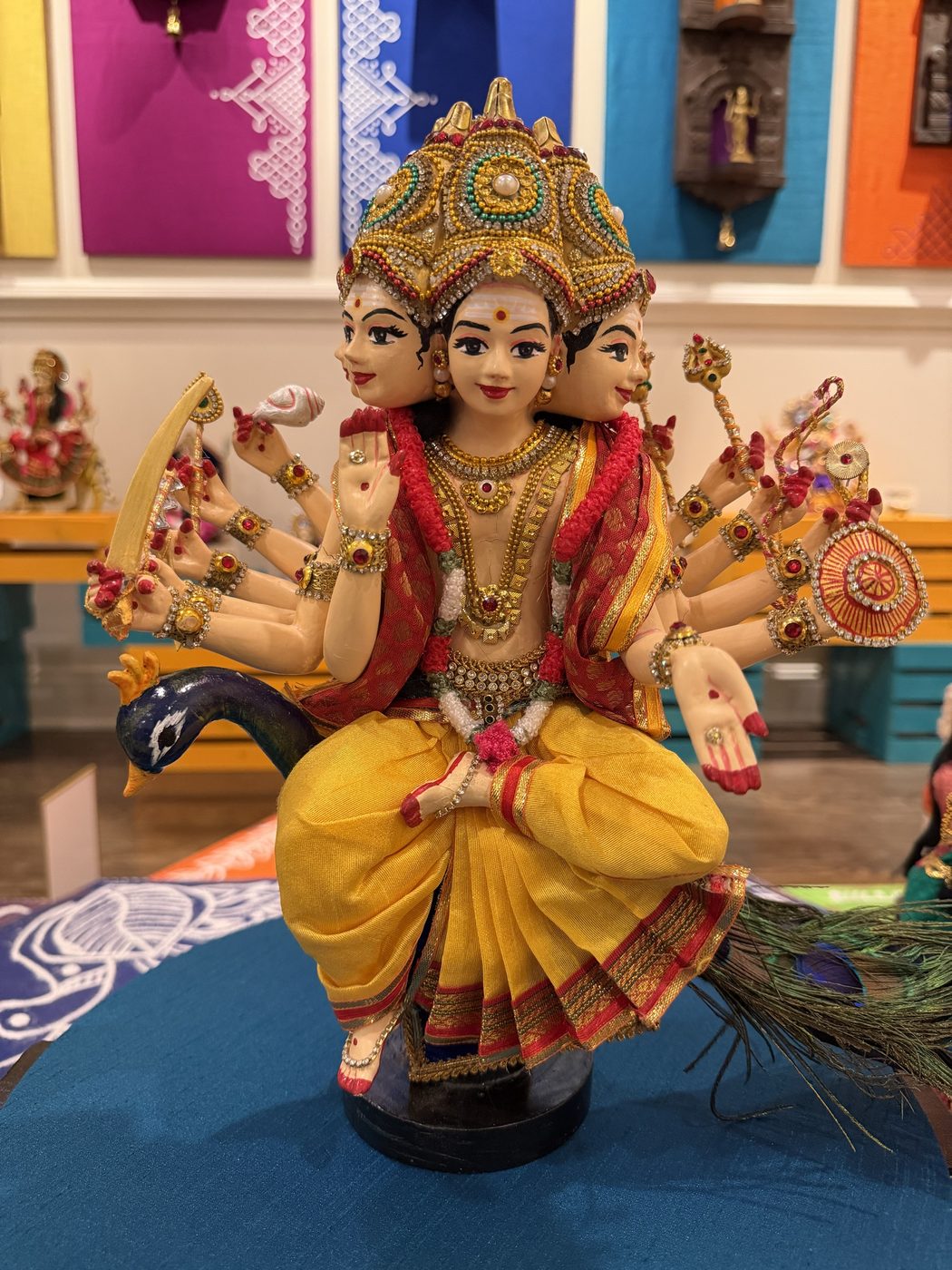
Golu doll of six-faced, twelve-armed Shanmukha seated on his peacock
Shanmukha, with six faces and twelve arms, on Mayil the peacock

As Shanmukha, the six-faced one, Murugan holds the six babies of Saravana Poigai in a single form, with six faces and twelve arms.

The ancient Tamil poem Thirumurugatruppadai, by the poet Nakkeerar, describes what each face does. One face spreads light so that darkness leaves the world. One lovingly grants the wishes of devotees. One watches over the prayers and fire rituals of the sages. One explains deep truths hidden from others. One fights and destroys evil. And one smiles with love at Valli.

In his hands he carries the Vel along with other weapons and signs of blessing. He rides Mayil, his proud peacock, and a rooster stands on his flag. As you will see in Chapter 6, both came from Surapadman himself.

Murugan is worshipped at six sacred temples in Tamil Nadu, the Arupadai Veedu, or six homes: Thiruparankundram, Thiruchendur, Palani, Swamimalai, Thiruthani and Pazhamudircholai.

Chapter 3

Swaminatha, the Little Teacher

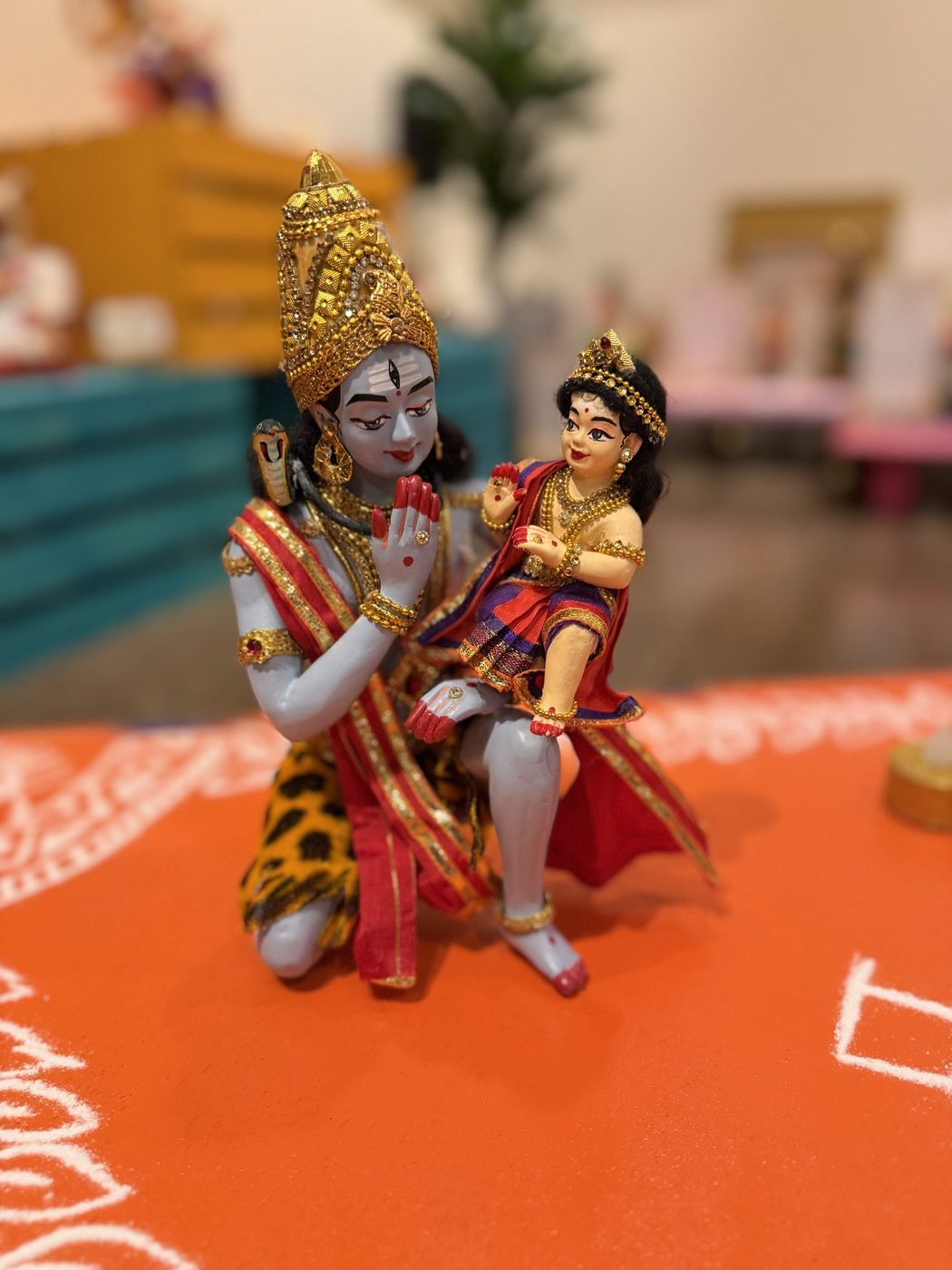
Golu doll of Shiva kneeling with his hand raised in respect while little Murugan sits on his knee
Little Murugan, seated on his father’s knee, teaches Shiva the meaning of Om

One day Brahma, the creator, came to Mount Kailash. Young Murugan asked him a simple question: what is the meaning of Om, the sacred sound from which all creation begins? Brahma chanted Om every day as he created the world, yet he could not explain what it meant.

So Murugan imprisoned Brahma. With the creator locked away, creation came to a halt.

Shiva intervened and asked Murugan to release Brahma, and Murugan obeyed. Then Shiva asked his son to explain the meaning of Om himself. Murugan agreed, but said such sacred knowledge must pass properly, from teacher to student. So Shiva sat humbly like a student, his hand over his mouth in respect, while his little son whispered the sacred teaching into his ear.

From that day Murugan was known as Swaminatha, the teacher of his own father, and Pranava Swaroopan, the embodiment of Om. The temple at Swamimalai, one of his six homes, celebrates this story.

Chapter 4

The Fruit of Wisdom

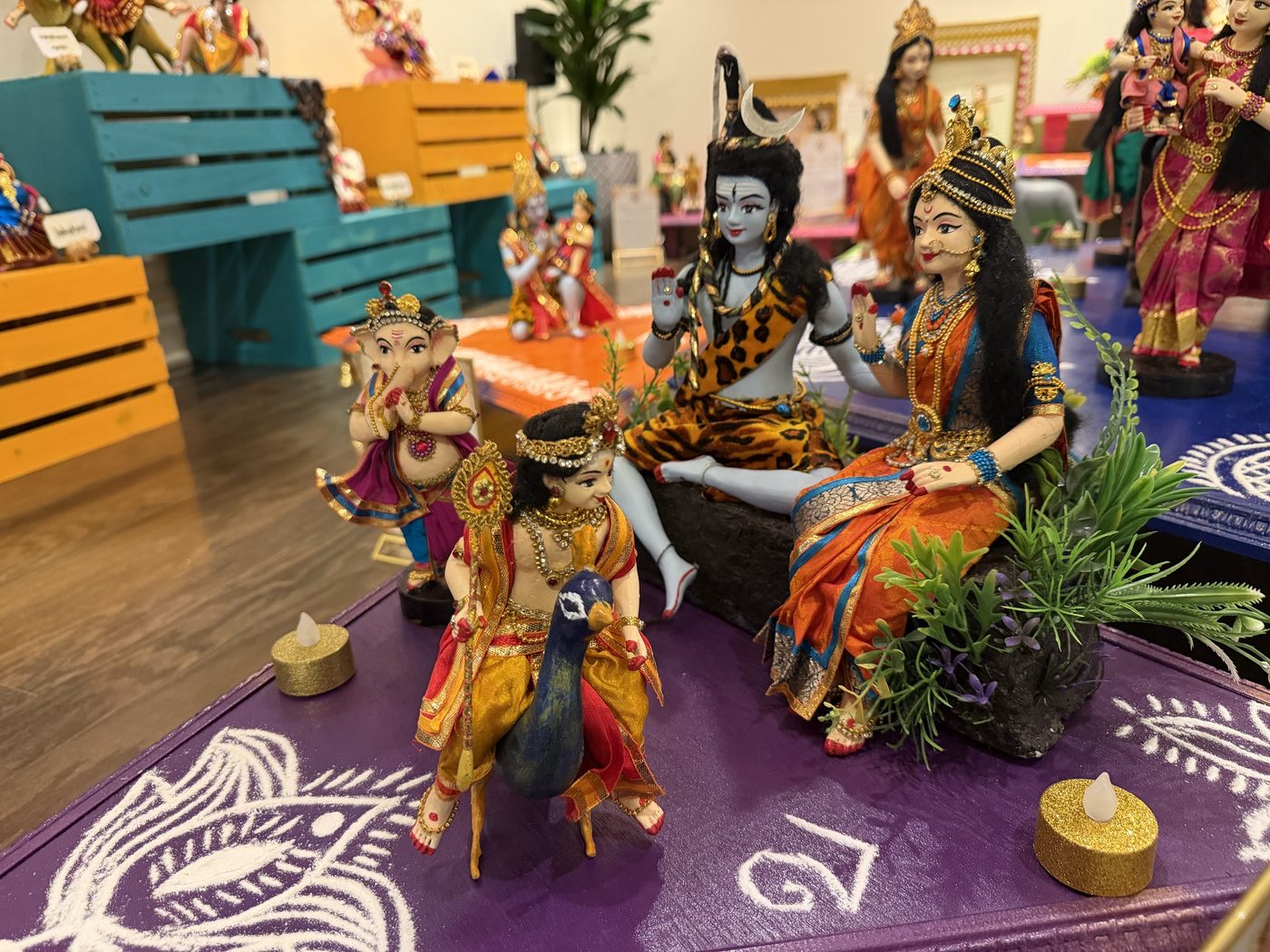
Golu dolls of Shiva and Parvati seated on a rock, with Ganesha praying and Murugan on his peacock before them
Ganesha and Murugan on his peacock before Shiva and Parvati

One day the sage Narada came to Mount Kailash with a single special mango, the Gnana Pazham, the fruit of wisdom, and offered it to Shiva and Parvati. There was one fruit and two sons, so they announced a contest: whoever went around the whole world first would win it.

Murugan leapt onto his peacock and flew off at once, over oceans, mountains and kingdoms. Ganesha, whose vehicle was a small mouse, thought for a moment. Then he walked slowly around his parents and said, “You are my whole world.” Pleased with his wisdom, they gave him the fruit.

When Murugan returned and found the fruit already given away, he was hurt and upset. He left Kailash, set aside his fine clothes and ornaments, and went to a hill in the south, where he stood alone as a young ascetic holding only a staff.

Shiva and Parvati followed him there and told him lovingly, “Pazham nee,” which means “You yourself are the fruit.” The hill became known as Palani, one of Murugan’s six homes, where he is worshipped as Dandayudhapani, the one who holds the staff.

Chapter 5

Parvati Gifts the Vel

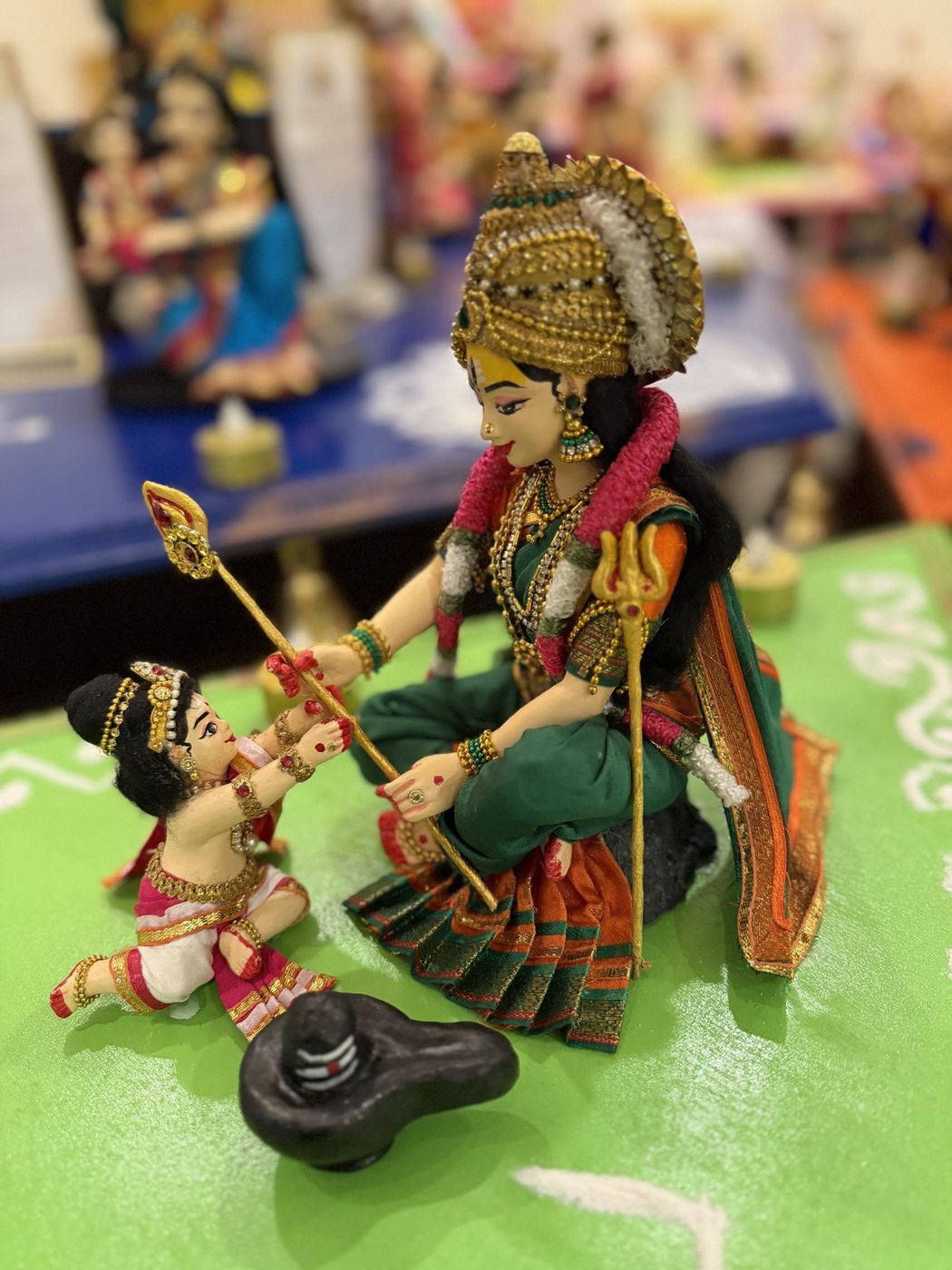
Golu doll of Parvati handing the Vel to little Murugan, who reaches up for it beside a Shiva lingam
Parvati blesses Murugan and gives him the Sakthi Vel

The devas were suffering under the tyranny of Surapadman and his brothers, and they sought help from Shiva and Parvati. Murugan had been born for exactly this purpose, to lead the army of the devas and restore dharma, and Shiva made him their commander.

Before Murugan left for battle, his mother Parvati blessed him and gave him the Sakthi Vel, a shining spear that holds her own power, her Shakti, and her grace. The Vel is often explained as a symbol of knowledge: sharp at the tip, broad in the middle and deep in its long shaft.

At the temple in Sikkal, Murugan is said to receive the Vel from his mother before the battle. During the festival there, devotees say the image of Murugan sweats as he prepares to go to war.

With his mother’s blessings and the Vel in his hand, Murugan set out to confront Surapadman. The Vel became the instrument through which he removed evil and protected the world, and devotees still praise it with the chant “Vetrivel Muruganukku Arohara!”

Chapter 6

The Defeat of Surapadman

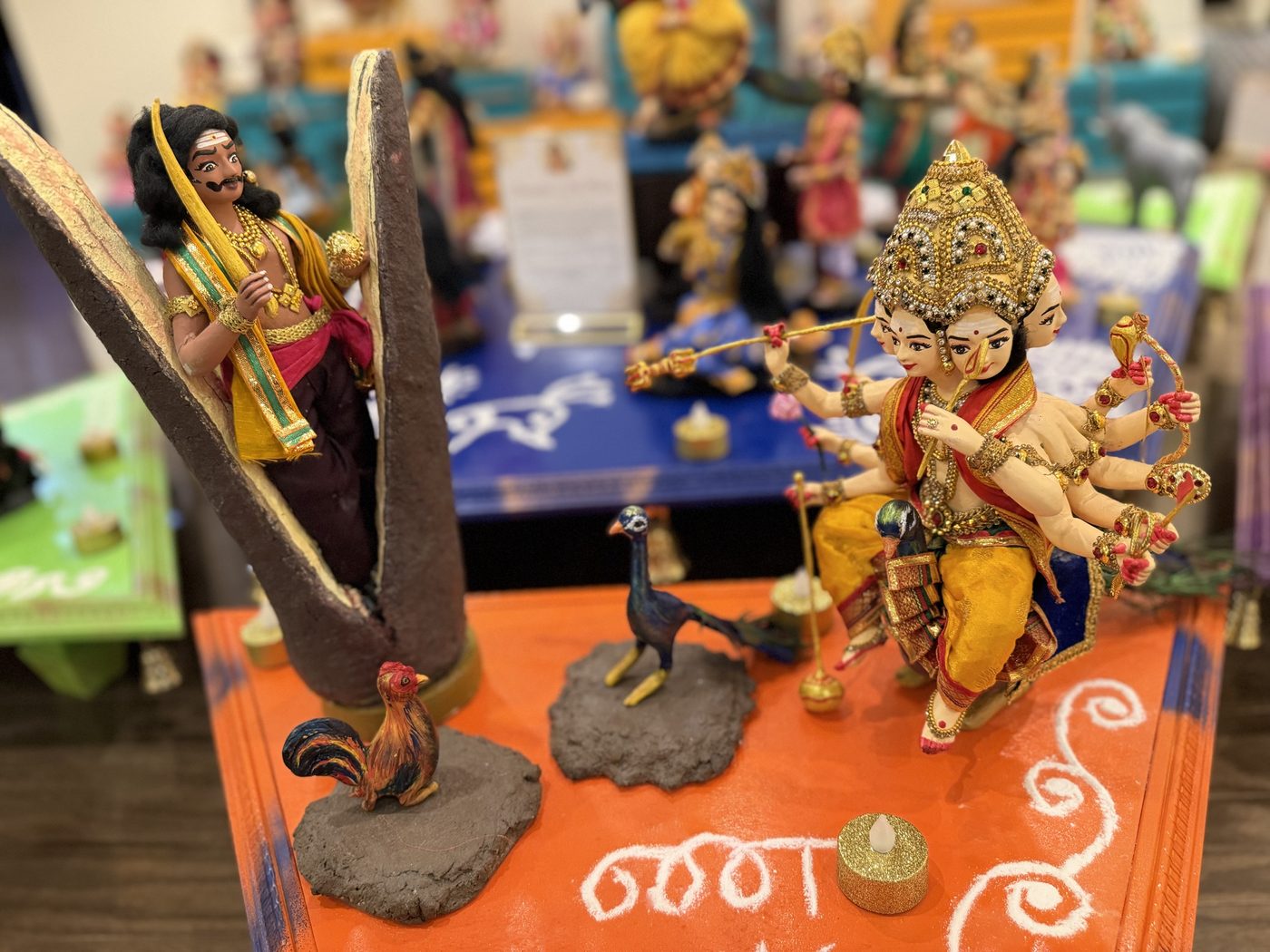
Golu dolls of Surapadman inside a split mango tree facing Shanmukha on his peacock, with a rooster and a peacock between them
Surapadman in the split mango tree faces Shanmukha, with the rooster and peacock the two halves became

Murugan led the army of the devas south and camped at Thiruchendur, on the shore of the sea. Across the water stood Veeramahendrapuri, Surapadman’s island fortress. First Murugan sent his commander Veerabahu as a messenger, asking Surapadman to free the devas. Surapadman refused.

The war lasted six days. As Shanmukha, with six faces and twelve arms, Murugan defeated Surapadman’s brothers and his vast armies one by one.

At last Surapadman faced Murugan himself. Murugan even showed him his cosmic form, but Surapadman’s pride would not let him surrender. Using his magic, he hid in the ocean as a giant mango tree. Murugan hurled his Vel, and it split the tree in two.

Even then, Murugan showed mercy. One half of the tree became Mayil, the peacock that carries him, and the other became the rooster on his flag. The asura was not simply destroyed but transformed, to serve forever the one he had fought.

This victory is celebrated every year as Soorasamharam on the sixth day of Kandha Sashti, and it is acted out on the beach at Thiruchendur.

Chapter 7

Murugan Weds Devayani

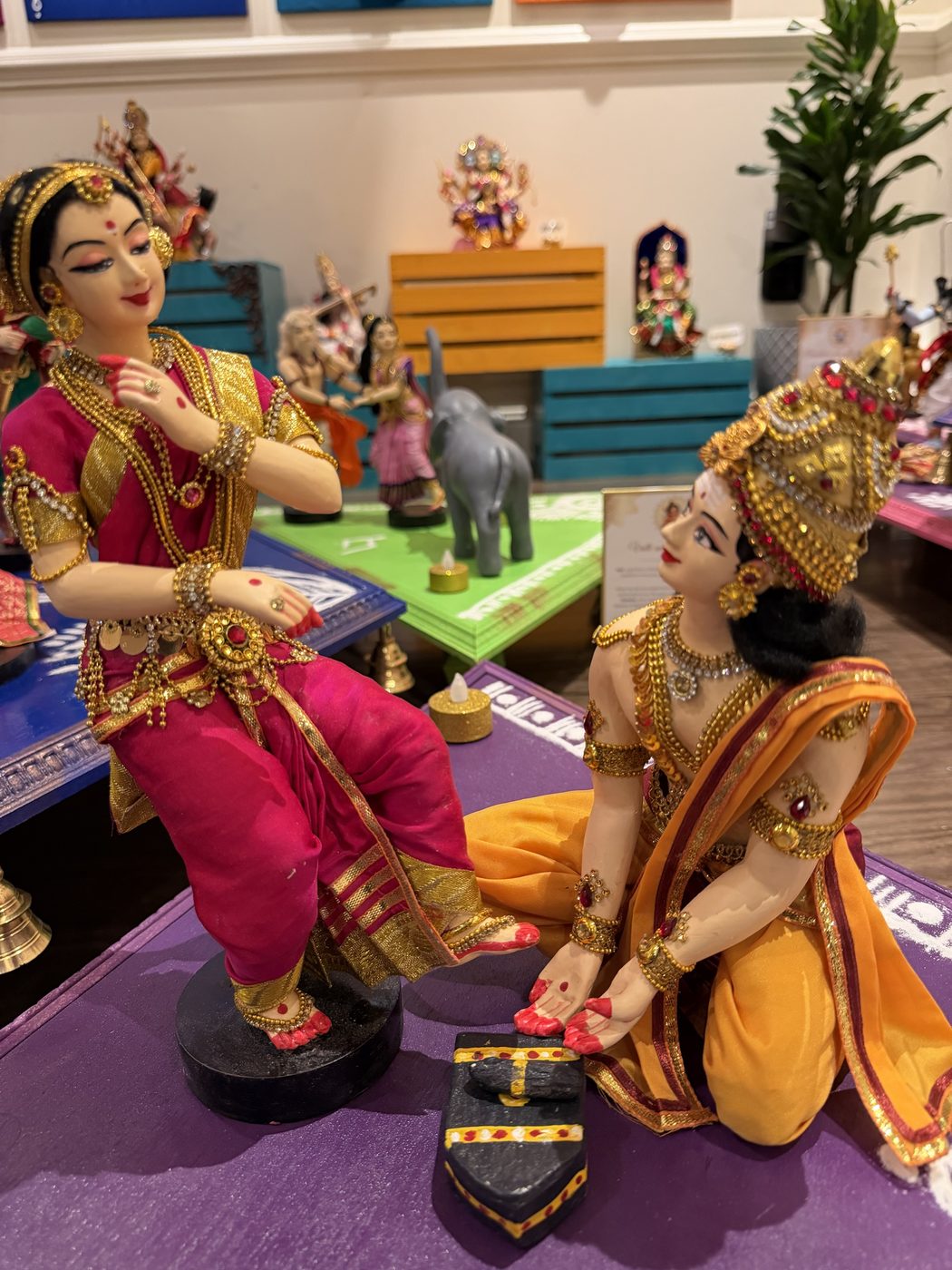
Golu dolls of Murugan kneeling and placing Devayani’s foot on the ammi, a grinding stone
Murugan places Devayani’s foot on the ammi

After Murugan defeated Surapadman and freed the heavens, Indra, the king of the devas, was overjoyed. To thank him, Indra gave his daughter Devayani to Murugan in marriage. She is also called Deivanai, because she was raised by Indra’s white elephant, Airavata. In Tamil, deiva yanai means divine elephant.

The wedding took place at Thiruparankundram, near Madurai, with the devas gathered to bless the couple. Thiruparankundram is the first of Murugan’s six homes.

Our golu shows a custom from Tamil weddings. The groom gently places the bride’s foot on the ammi, a flat grinding stone. This is called ammi midhithal. Just as the stone stays steady whatever is ground on it, the bride is wished a heart that stays strong through life’s ups and downs. The groom then slips silver metti, toe rings, onto her toes.

Here the mighty warrior of the Vel kneels humbly at his bride’s feet.

Chapter 8

Valli and the Elephant

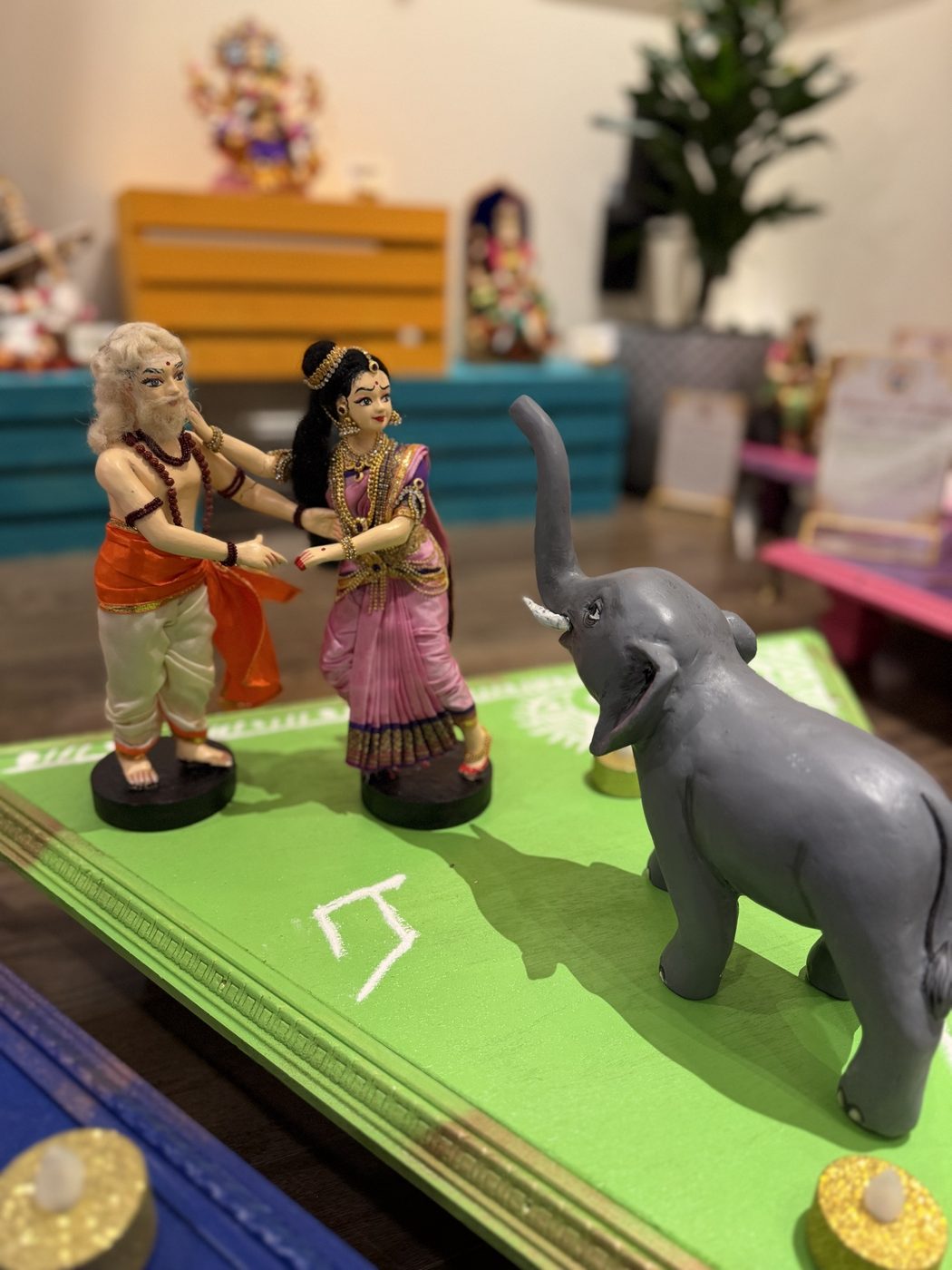
Golu dolls of Valli running to the old sage as a wild elephant charges
Frightened by the elephant, Valli runs to the old sage

Valli was found as a baby among the valli creepers by Nambi Raja, chief of a hill tribe, who raised her as his own daughter. When she grew up, she guarded the family’s millet fields, chasing away the birds.

Murugan wished to marry her. He came to her in disguise, and at last as a frail old sage. He asked her for food, then for water, and then asked her to marry him. Valli was shocked and turned to run.

Murugan quietly called on his elder brother Ganesha for help, and Ganesha came charging out of the forest as a wild elephant. Frightened, Valli ran straight into the old sage’s arms and promised to marry him if only he would save her.

At once the sage became young Murugan, and Valli saw that the one she had loved all along had come for her. After a chase by her family, Nambi Raja happily gave her in marriage. In Murugan’s temples, Valli and Devayani stand on either side of him.

Vetrivel Muruganukku Arohara!

Thank you for visiting Srivatsa’s Golu. Tap a star at the top to revisit any chapter.